
Student Spotlight
Rayne Lewis
By Ainsley Weems | MSU Communication Student Class of 2026
Fourth-year architecture student Rayne Lewis recently presented at the College Art Association’s (CAA) 114th Annual Conference in Chicago, Illinois. The CAA Conference is held every February and serves as the the largest convening of art historians, designers and visual art professionals.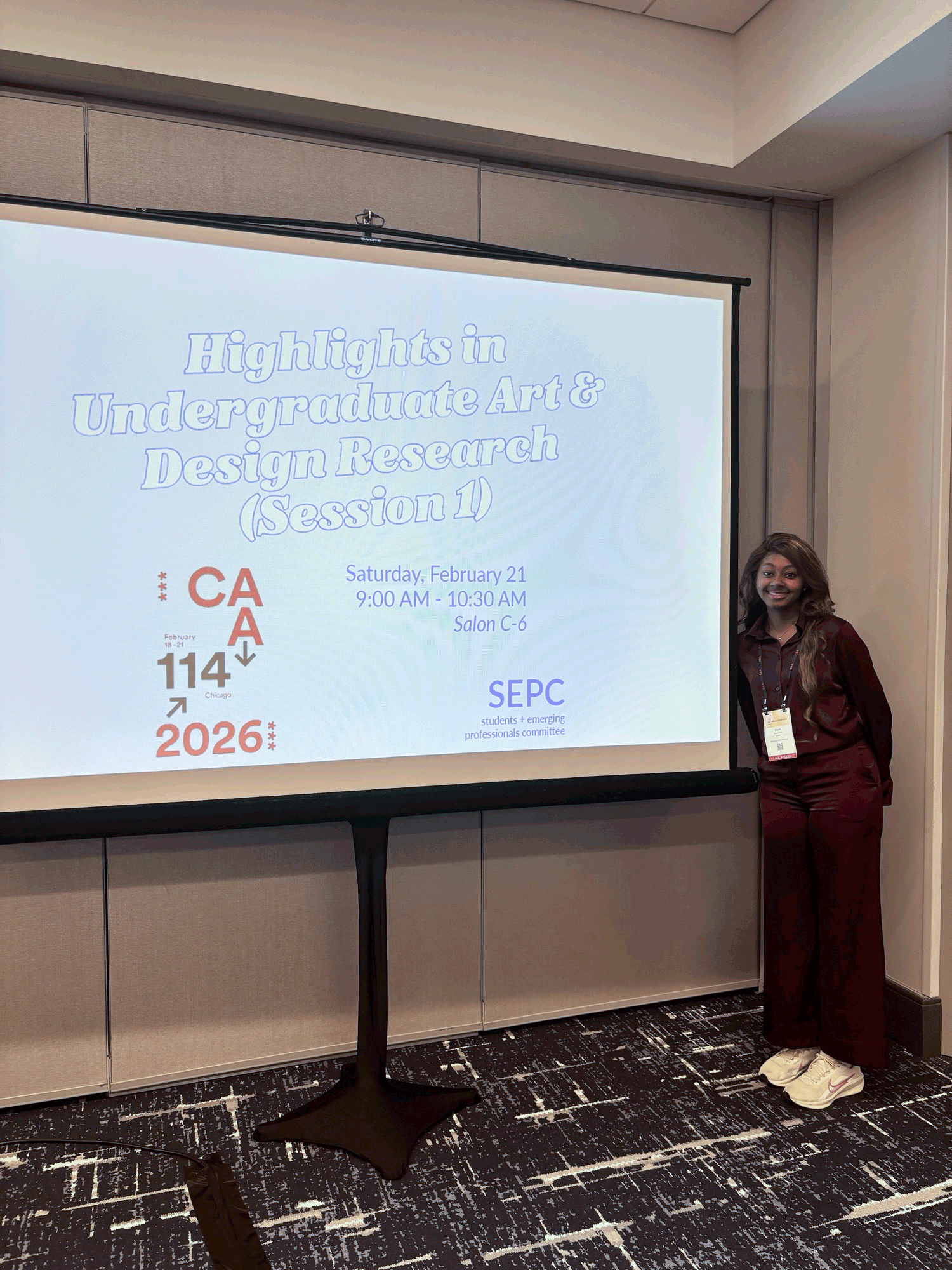
Lewis’s presentation, “The Porch as Threshold: Documenting Memory, Space, and Belonging in Pocahontas, Mississippi,” originated from a summer course project in ART 1023: History of Art Post–1300s. She chose to research the intersections of memory and porch culture as “spaces of visibility, exclusion and generational memory.” To document the built environment, neighborhood dynamics and capture oral history/testimonials, Lewis traveled to her grandmother's neighborhood in Pocahontas.
“In interviewing my grandmother, a key moment was when she described how the porch functioned as both a social and emotional threshold,” Lewis said. “That shifted my research toward understanding porches as spaces of connection rather than just architectural elements.”
In her paper, she examined how porches serve a central and vital role in Black communities in the South as thresholds between personal identity and public life. This project resulted in Lewis taking another look at porches and her hometown, thinking deeper about what defines a “home”.
“This experience has redefined ‘home’ as something constructed not just physically, but through memory, interaction and spatial relationships,” Lewis said. “Documenting my hometown revealed how architecture quietly shapes belonging, especially through everyday spaces that often go unnoticed.”
Through this project, Lewis learned that being able to connect personal narratives with spatial analysis has value in architectural discourse. This experience gave her the confidence that her perspective is worth contributing to the field and continue analyzing the world around her.
“Southern architectural elements like porches are often overlooked as purely aesthetic or nostalgic, rather than being understood as critical social infrastructures,” Lewis said. “This project will continue to influence my studio work by encouraging me to design with a deeper awareness of cultural and environmental context.”