Tarlan Abazari
Indoor Health & Environmental Analytics Lab (i-HEAL)

Assistant Professor Tarlan Abazari | School of Architecture and Department of Interior Design
Dr. Tarlan Abazari leads the Indoor Health & Environmental Analytics Lab (i-HEAL), where she investigates the integration of biophilic design, neuroarchitecture, and human-centered design as a comprehensive framework for creating healthy and productive educational environments. Her research examines the impact of interior spatial conditions on cognitive performance, emotional well-being, and user experience, particularly within design studio settings where sustained attention and creativity are essential. Human-centered design is central to the i-HEAL, framing the relationship between users and indoor environments. The lab treats interior spaces as active systems that shape behavior, interaction, and cognition. It integrates biophilic design to study how natural elements support cognitive restoration, reduce stress, and enhance well-being. It also draws on neuroarchitecture to examine how spatial conditions, including form, light, materiality, and sensory stimuli, influence neurological and psychological responses, advancing evidence-based approaches to improving learning and performance.
i-HEAL runs two active research projects:
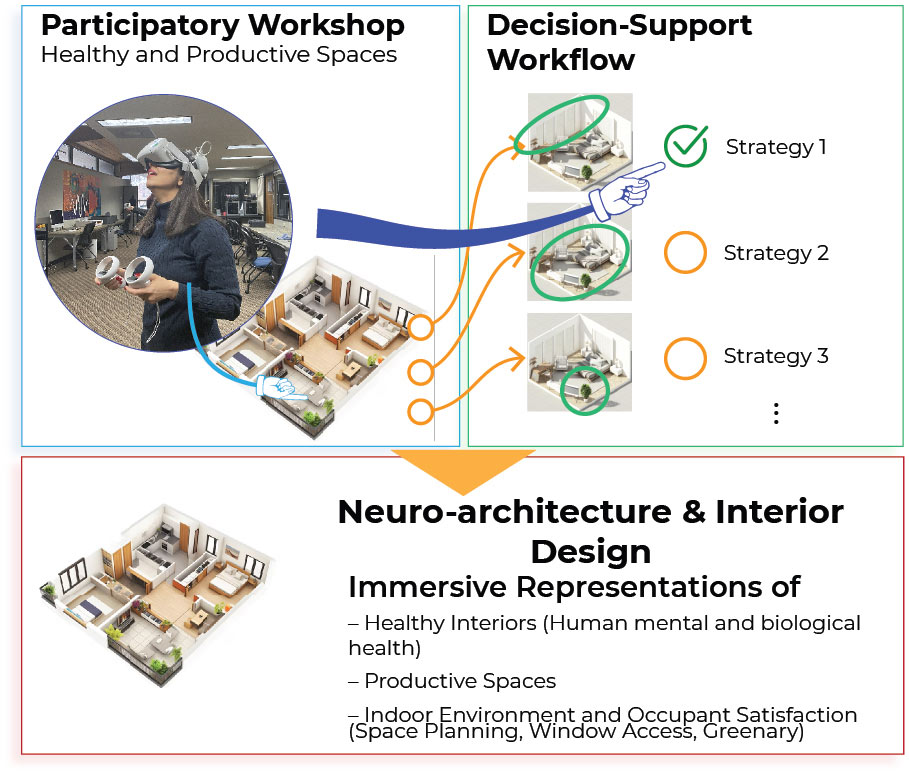
The first project, “XR-Driven Interior Design for Healthy and Productive Learning Spaces” funded by the CAAD Catalyst Grant and it evaluates how personalized and varying levels of biophilic integration, from minimal to highly immersive interventions, affect cognitive functions such as memory retention, problem-solving, focus, and decision-making.
Second project, “Reimagining School Spaces: Climate-Adaptive Interior Design through VR-Enabled Co-Design with K–12 Students” develops a virtual reality–enabled co-design platform with K–12 students to inform the creation of climate-adaptive school interiors that support human health and well-being. It investigates how immersive, participatory design processes influence students’ creativity and cognitive performance while shaping more responsive and sustainable learning environments.