
Critz Campbell
Federal Art in Architecture Commission
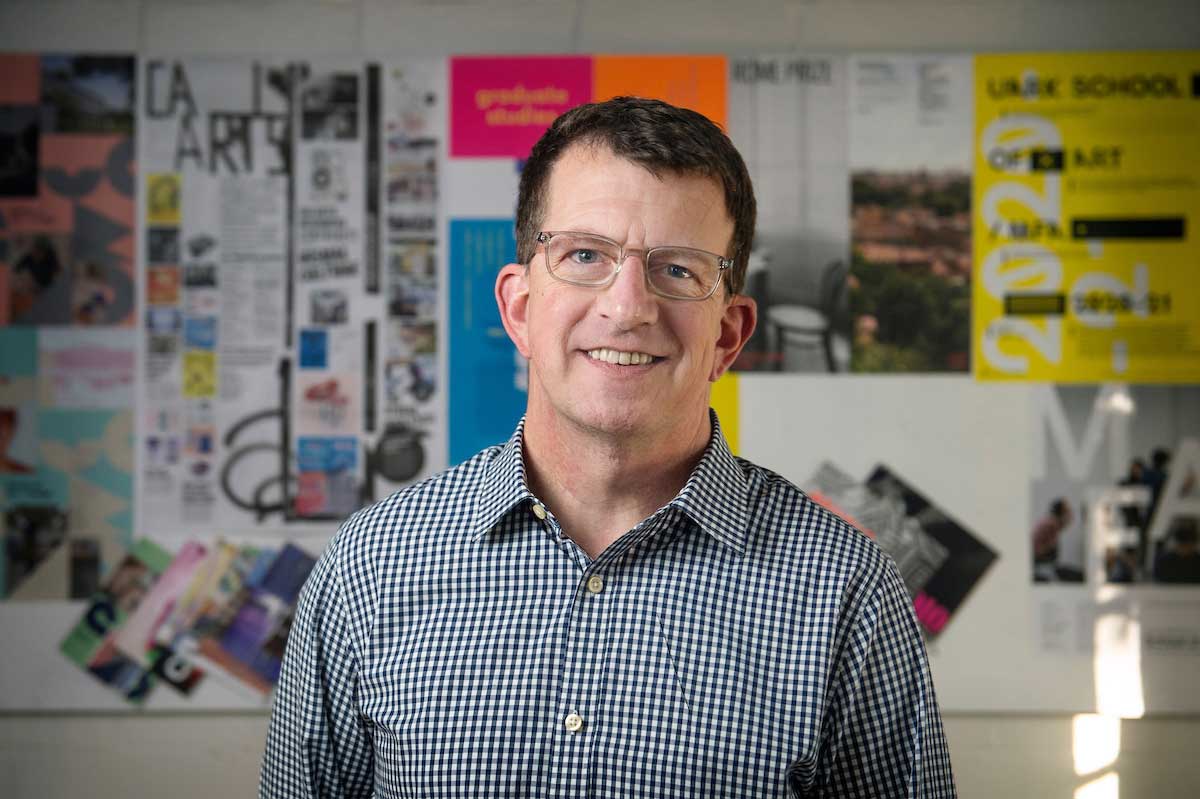
Professor Critz Campbell | Department of Art
Project overview
Professor of Art, Critz Campbell recently completed the installation of a federal Art in Architecture artwork commissioned for a new federal courthouse in Greenville, Mississippi. The commission was awarded through the General Services Administration’s (GSA) nationally recognized Art in Architecture Program. This commission integrates original, site-specific artwork into the building’s design, contributing a cultural dimension to the civic space.
The new federal courthouse in Greenville represents a significant federal investment in the Mississippi Delta, with a $45.3 million project led by the U.S. General Services Administration and designed by CAAD alumni Duvall/Decker Architects. Situated in the historic downtown district, the approximately 55,000-square-foot facility will house district and magistrate court functions while improving security, accessibility, and operational efficiency for the Northern District of Mississippi. Beyond its judicial purpose, the project has been positioned as a catalyst for downtown revitalization, reflecting strong collaboration between federal partners and the local community.
Objectives and significance
The Art in Architecture commission for the new federal courthouse is designed to integrate original, site-specific artwork into the core of a major civic building, making art an essential part of the public environment rather than an afterthought. Administered by the U.S. General Services Administration, the program allocates approximately one-half of one percent of construction funding to support permanent works developed in collaboration with the architectural design. Beyond aesthetics, these commissions create a lasting cultural legacy by transforming federal buildings into spaces that reflect public values, identity, and democratic ideals. In the Greenville courthouse, the artwork contributes to the symbolic presence of justice while supporting downtown revitalization, positioning the building as both a functional legal institution and a meaningful cultural landmark for the community.
Explain why the work matters to your field, to CAAD, or to broader communities
The selection of Critz Campbell for a federal Art in Architecture commission represents a meaningful achievement for Mississippi State University’s College of Architecture, Art & Design, underscoring the college’s role in fostering faculty whose creative work operates at a national level. GSA commissions are highly competitive and nationally recognized, positioning Campbell’s selection as both a professional distinction and a reflection of the college’s commitment to excellence in research and creative practice. For Campbell, the commission advances his national reputation as a visual artist by placing his work within a prominent federal project, expanding its visibility and impact within the broader discourse of contemporary public art while reinforcing his leadership as both an educator and practitioner.
Methods or approach
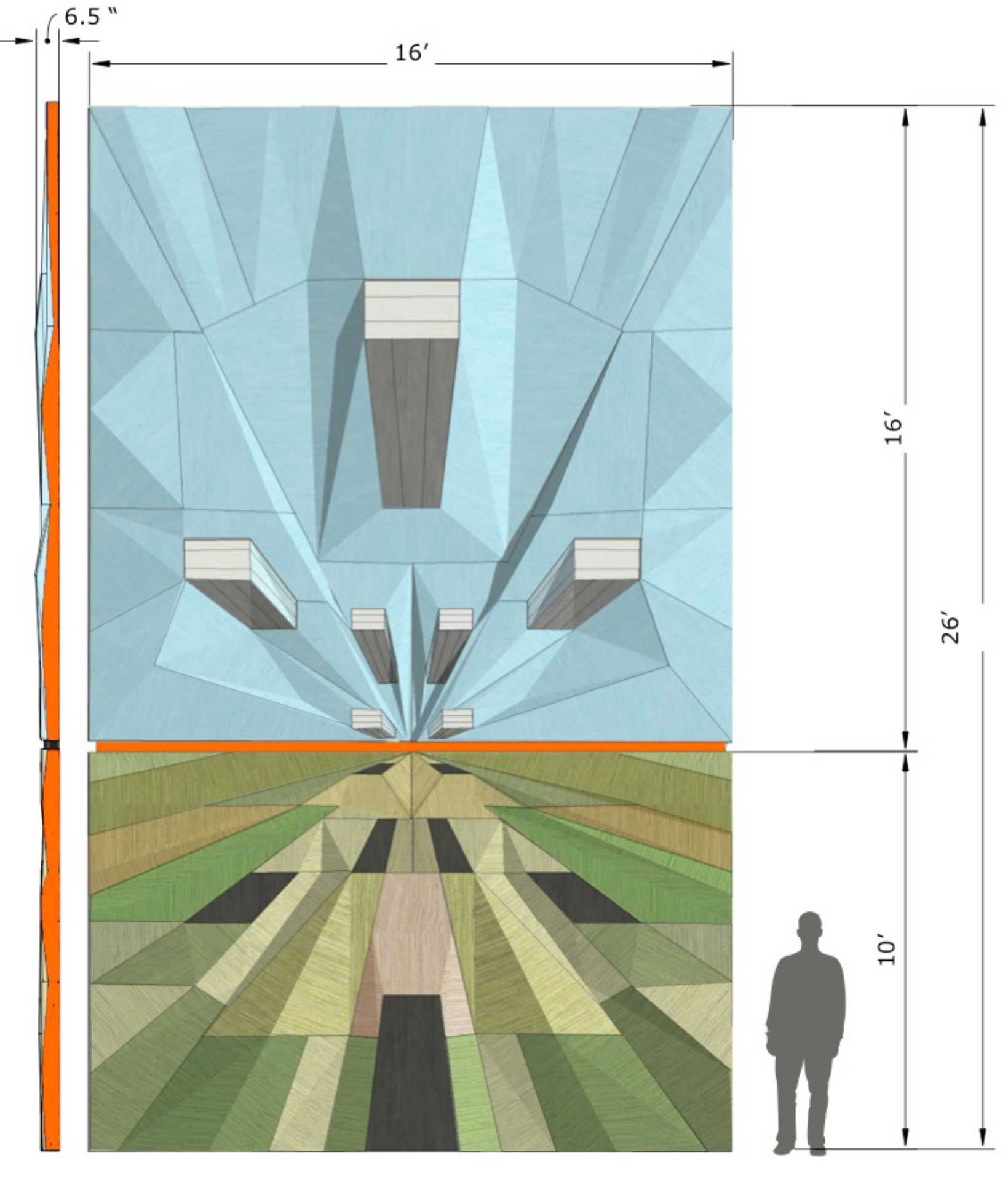
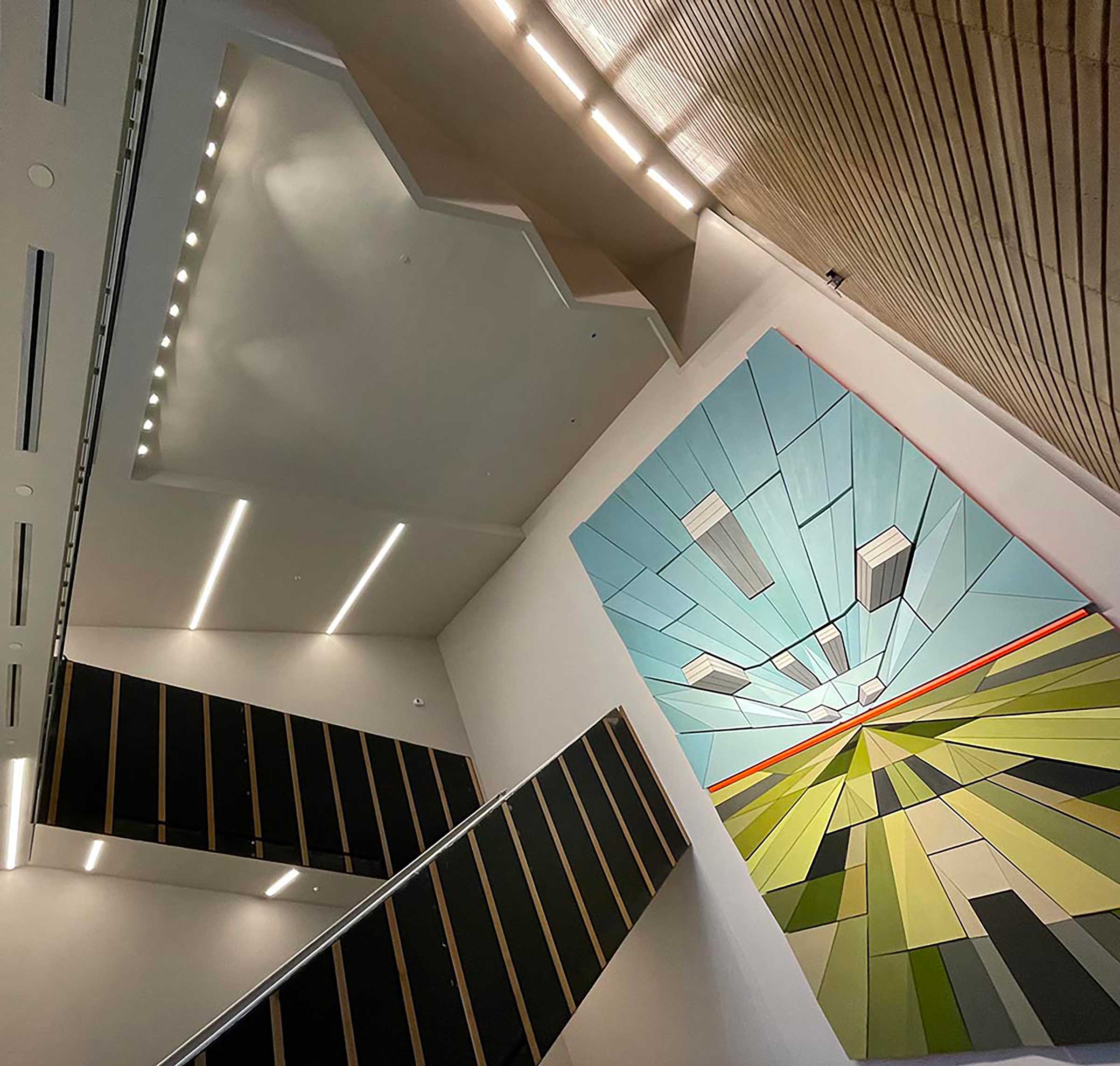
Critz Campbell approaches his work by blending abstraction with a strong sense of place and material. In Cloud Field Ferry, he built the composition around a central vanishing point, using simplified forms drawn from the river, farmland, and sky to create a clear but layered visual language. His process is very hands-on—especially in the fabrication and hand-burnished wood surfaces—which softens the geometry and gives the work a tactile, human quality, similar to a quilt or stained glass. Repetition, symmetry, and shifting viewpoints make the piece feel active as you move through the space, while elements like the seven suspended forms leave room for interpretation, suggesting ideas like migration, balance, or the passage of time. Overall, the work balances structure and openness, inviting viewers to slow down and connect it to both the landscape and their own experience.
Summarize the research or creative methods, approaches, or processes used in the project in concise terms
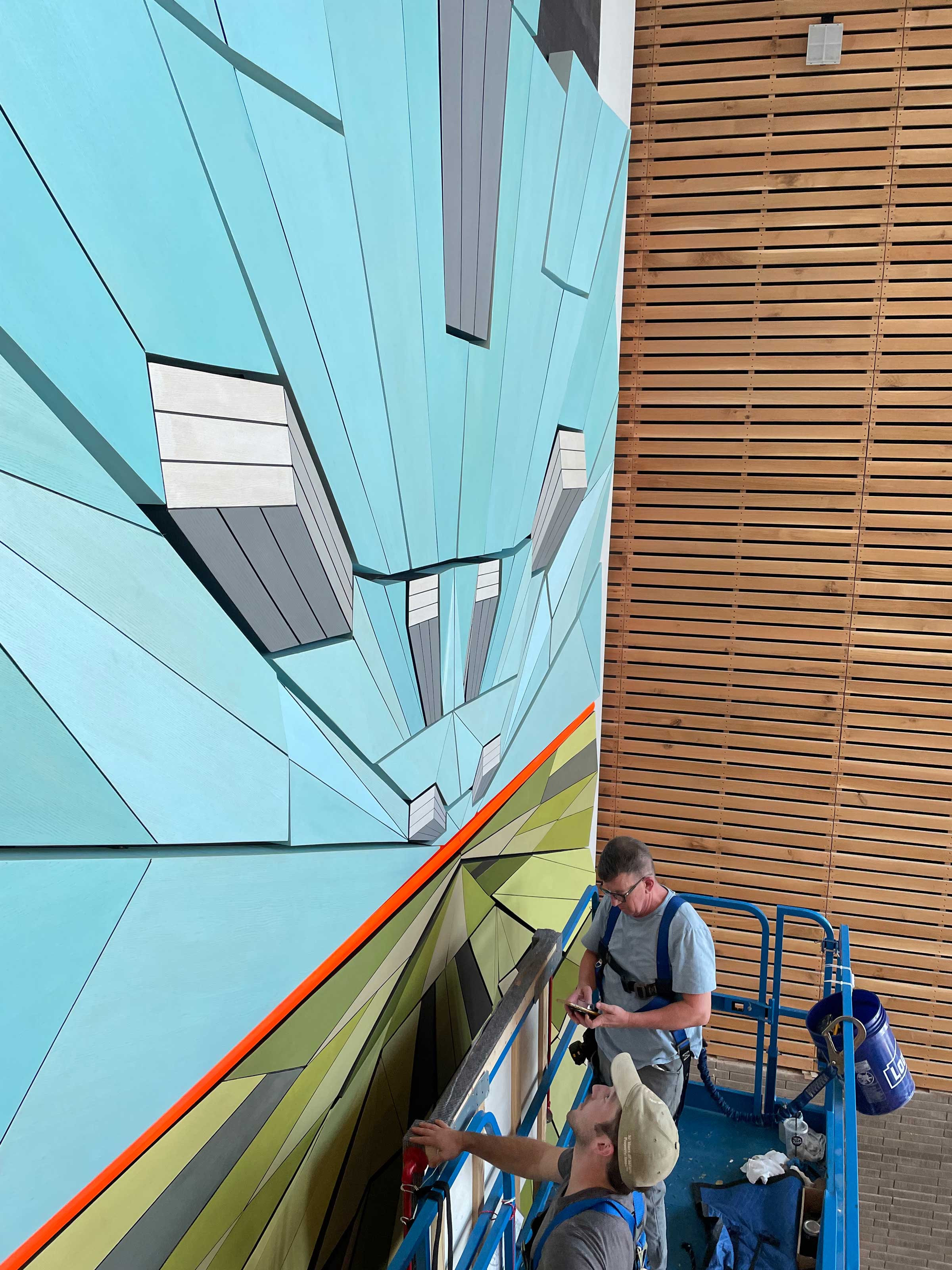
Cloud Field Ferry combines conceptual design, material experimentation, and site-specific installation into a unified process. Professor Campbell developed the work through studio fabrication, constructing 64 individual, hollow bodied panels by hand using Ash veneer on plywood substrates, layered acrylic color, and protective finishes. The approach integrates digital planning (panel layouts and shop drawings) with hands-on craftsmanship, allowing for precision while maintaining a tactile quality. Installation functioned as an extension of the creative process, with panels arranged and adjusted in real time on-site to refine spacing, alignment, and visual impact from multiple viewpoints. The method emphasizes responsiveness to architecture, light, and viewer movement, resulting in a work that is both formally structured and dynamically experienced within its specific environment.
Key outcomes, products, or impacts
The final design of Cloud Field Ferry resulted in a finished artwork that is 16’ wide by 28’ tall. The artwork is mounted in the three-story atrium of the new courthouse at a height of nearly fifty feet. Cloud Field Ferry is now part of the permanent fine art collection of GSA. It will be cared for by GSA and viewed by generations of visitors to the Greenville facility.
Future directions
This is the first major public commission for Professor Campbell. He intends to pursue future opportunities in the public sphere. He is currently constructing a display space at his home studio that will allow for the execution and display of larger artwork.
If relevant, note next steps, follow-on work, or planned extensions of the project
The Courthouse is in its final stages and completion. Professor Campbell and CAAD are anxiously anticipating the grand opening of the building and look forward to seeing Cloud Field Ferry in its permanent home.