
Tess Higginbotham recently earned first place in the Humanities Special Area Competition of Mississippi State University’s Spring 2026 Undergraduate Research Symposium.
Higginbotham, a incoming fourth-year architecture student from Athens, Alabama, said she decided to participate in the symposium to get practice “consolidating research into a packaged artifact for presentation.”
Her project, “Drawing as Pedagogy in Architectural History Education,” was funded by the College of Architecture, Art and Design’s Creative Research Experiences for Undergraduates Grant. For the symposium, Higginbotham researched the teaching philosophy and methodology of late Professor Emeritus of the School of Architecture Michael Fazio.
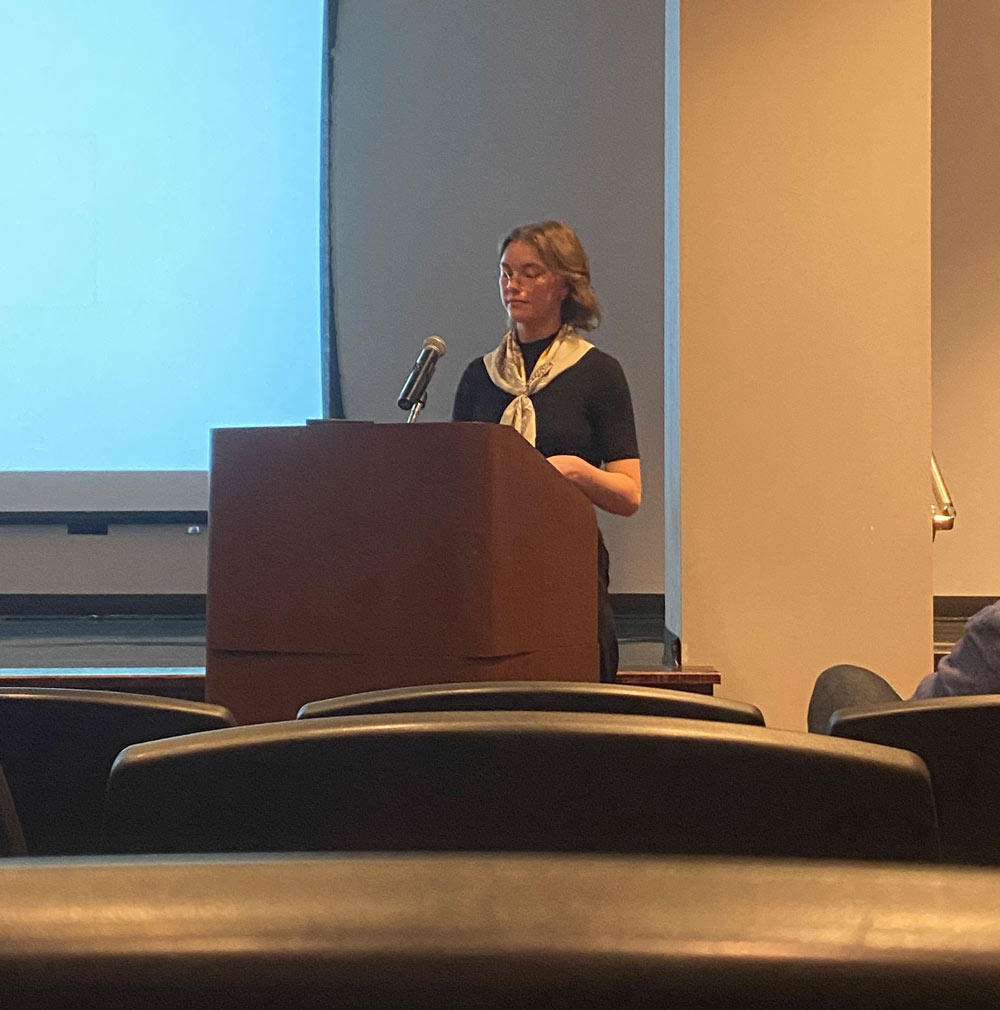 Her work was guided by her faculty advisor Assistant Professor Aaron White, who encouraged her to search for inspiration in Fazio’s archived files at the library.
"Dr. Fazio had such a profound influence on the school,” White said. “I had known that the library had a collection of his materials for some time. All I did was alert Tess to that fact. It's been rewarding not only to watch her pursue this project with such rigor, but to see Dr. Fazio's continuing influence on our students."
Higginbotham said this was her second year to present research at the symposium, and she said that she felt more prepared this year.
“The jury questioning afterwards is by far my favorite part,” she said. “It’s really a chance to have a discussion about the work rather than just presenting information and leaving—it feels more rewarding in a sense.”
Higginbotham said she is still researching this topic and hopes to produce a full-length paper.
“The symposium was a nice check point to stop and examine my project where it is and evaluate what questions I still have and what broader information I need to gather,” she said.
The architecture student said she doesn’t think many of her peers realize that MSU encourages research exploration and offers funding for it. She said it’s not for everyone but had some advice for those that were interested in getting started.
“Just start reading things, observing things and writing things down,” she said. “You don’t have to sound smart; you can do the thinking on paper and fix it later. The point is to use your brain like a designing and comprehending muscle and constantly practice.”